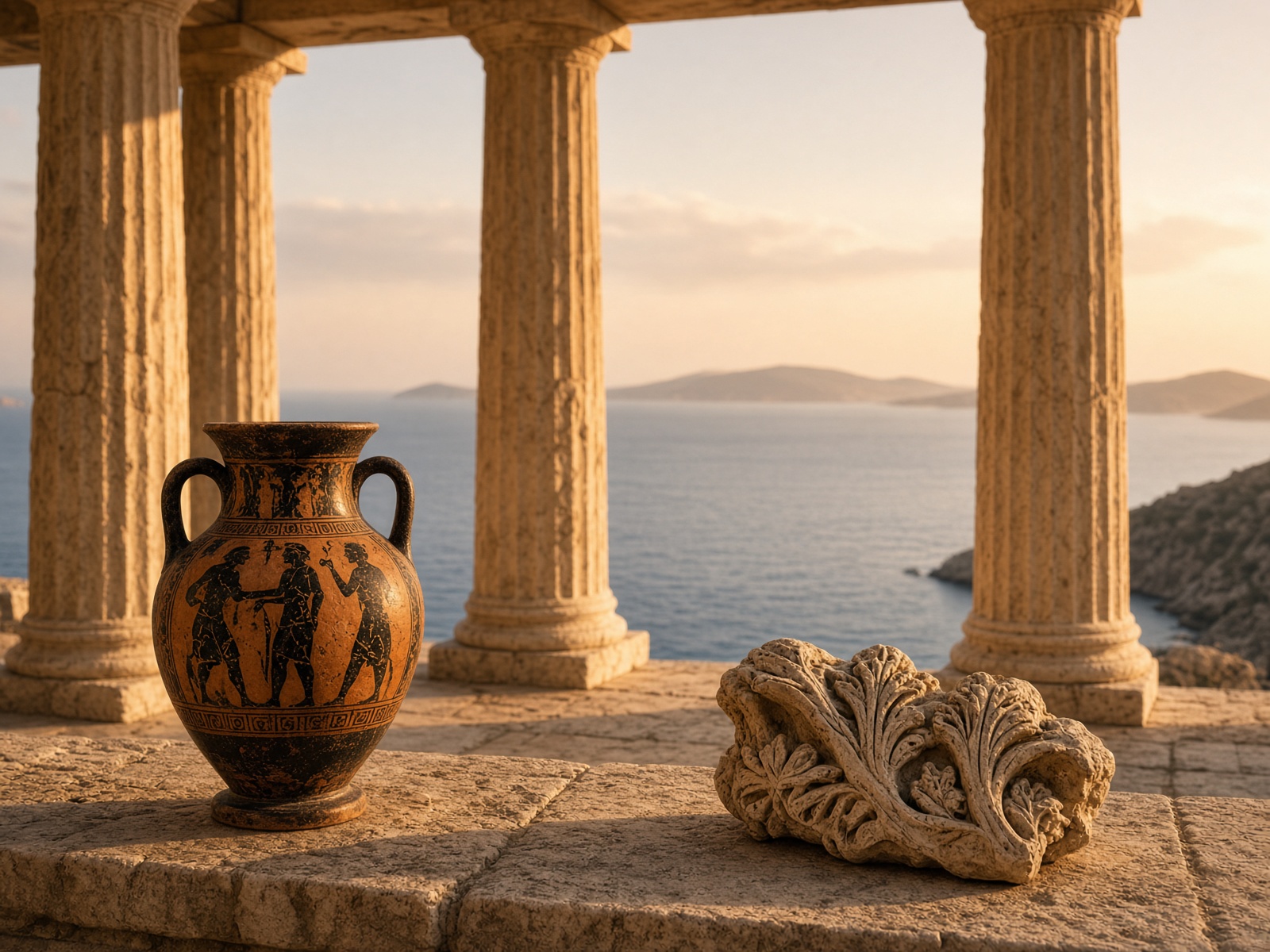
c. 800–300 BCE
Ancient Greek
Epic song, civic tragedy, and the first philosophy written as literature. The West learns how a story can found a people.
The climate of the age
In the city-states of the Aegean, oral poetry hardens into written epic while Athens invents theater as a public rite. Homer’s hexameters travel with traders and colonists; later, the tragic festivals turn myth into civic argument. Philosophy, lyric, and history appear as distinct arts, all still close to performance.
Greek literature supplies the West with its first canon of forms—epic, lyric, drama, history, dialogue—and a vocabulary of fate, honor, and the examined life that later eras keep rewriting.
- Oral-formulaic epic and the hexameter line
- Tragedy and comedy as civic institutions
- Myth treated as usable public memory
- The birth of lyric voice and philosophical dialogue
Leading authors
Ancient Greek
Homer
c. 8th century BCE
The name attached to the two founding epics of Greek—and therefore Western—narrative. Whether one poet or a tradition, Homer gives the war at Troy and the long way home their durable music.
Ancient Greek
Sophocles
c. 496–406 BCE
Athenian tragedian who tightened drama around a single catastrophic recognition. His Theban plays remain the West’s most concentrated studies of knowledge that arrives too late.
Ancient Greek
Sappho
c. 630–570 BCE
Lyric poet of Lesbos whose fragments still feel like a living voice. Desire, ritual, and the suddenness of feeling survive in lines broken by time.
Ancient Greek
Aeschylus
c. 525–456 BCE
The first of the great Athenian tragedians. He stages justice as a problem that blood cannot solve, and the city as the only vessel large enough for the Furies.
Ancient Greek
Euripides
c. 480–406 BCE
The most modern of the tragedians, and the least consoling. He lets gods, women, and foreigners speak until the city’s stories about itself begin to crack.