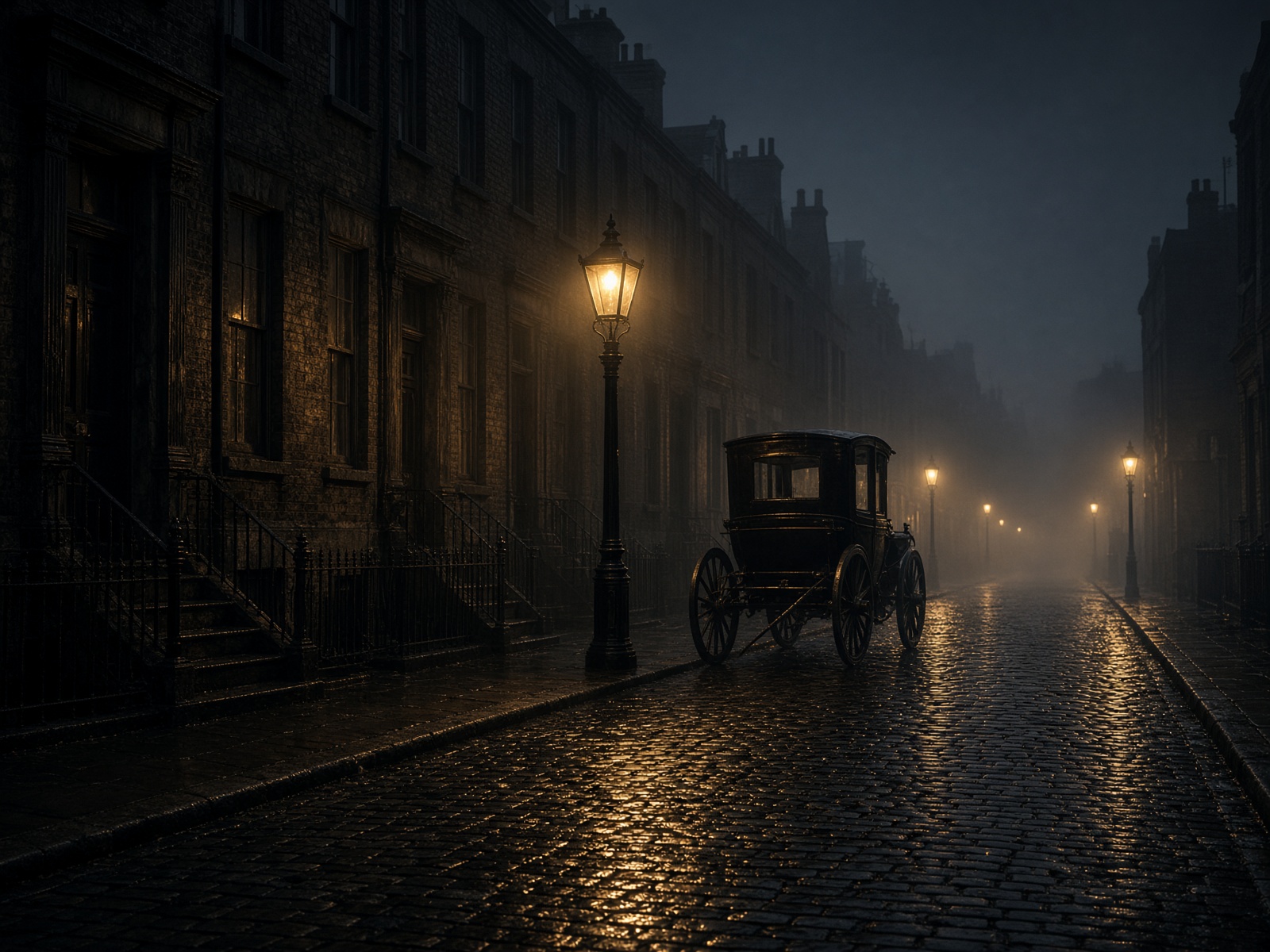
c. 1830–1900
Realism & Victorian
The novel becomes a city. Marriage plots, social systems, and the moral weather of ordinary rooms.
The climate of the age
Industrial cities, serialized magazines, and a vast new reading public make the novel the century’s dominant art. Realists treat money, class, and marriage as destiny; Russians enlarge the form into spiritual inquiry. The period’s confidence is matched by its unease.
This is the age that teaches us to read society as a plot. Its novels remain the default model of what a ‘book’ is for many readers.
- The panoramic social novel
- Free indirect style and moral irony
- Serialization and the chapter as pulse
- Domestic life as a field of fate
Leading authors
Realism & Victorian
Jane Austen
1775–1817
Hampshire novelist of courtship, money, and moral intelligence. Her irony is so fine it can feel like weather in a room.
Realism & Victorian
Charles Dickens
1812–1870
The Victorian city’s great showman and conscience. Serial novels turn fog, law, and childhood into popular epic.
Realism & Victorian
Leo Tolstoy
1828–1910
Russian count who wrote as if no human interior were closed to him. His novels hold private feeling and historical force in the same breath.
Realism & Victorian
George Eliot
1819–1880
Mary Ann Evans, writing as George Eliot, brought philosophical seriousness to English realism. Middlemarch remains a map of how a town thinks.
Realism & Victorian
Herman Melville
1819–1891
American sailor-novelist who turned a whaling voyage into metaphysics. Failure in his lifetime; afterward, the white whale became a national (and then a world) emblem of the unreadable.
Realism & Victorian
Gustave Flaubert
1821–1880
The saint of the sentence. Madame Bovary teaches Europe that style is an ethic, and that boredom can kill as surely as passion.
Realism & Victorian
Fyodor Dostoevsky
1821–1881
Novelist of the underground, the courtroom, and the soul that argues at 3 a.m. His Brothers Karamazov is a murder story that is also a theology.
Realism & Victorian
Emily Dickinson
1830–1886
Amherst recluse who rebuilt English from the inside. Dashes, riddles, and a God addressed with terrifying intimacy.
Realism & Victorian
Joseph Conrad
1857–1924
Polish exile writing English as a second (or third) language, and making that friction part of the art. Heart of Darkness is the century’s most fought-over short novel of empire.